The Marriage Contract, 2027
The prenup you sign when you don't sign a prenup
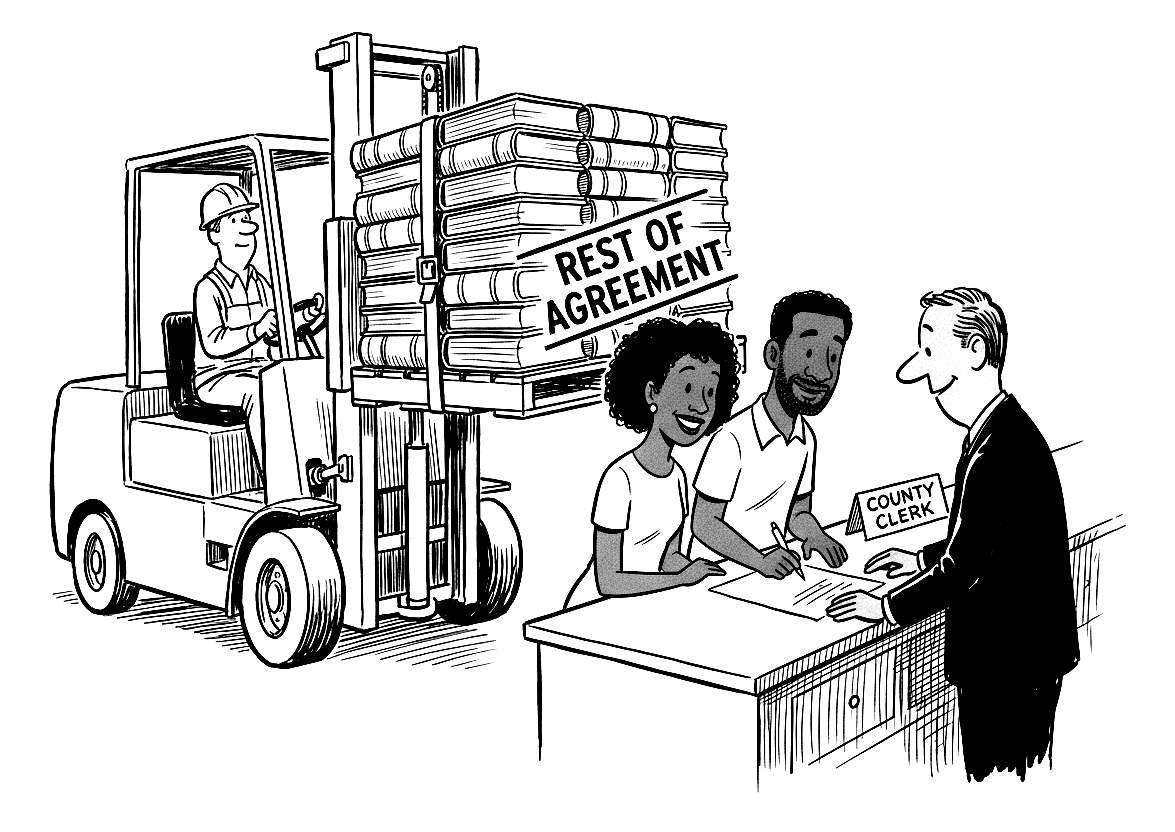
If you're married, you have a prenup. Your state wrote it. It runs to a few thousand pages of statutes and court decisions, it decides who owns your paycheck, who owes your spouse's hospital bill, and who inherits, and it changes when you move. You agreed to all of it by signing a one-page license. Nobody handed you the rest.
This book is the rest, read to you clause by clause. Every term appears twice: once as a lawyer would have drafted it if anyone ever had, and once in English. Words that look like this mark the places where the contract doesn't give an answer and hands the question to a judge you haven't met.
Should you buy it?
Probably, if
- You're married and wondering what you agreed to. You're the main audience. It isn't too late to change any of it.
- You're about to be. You may find the default already does what you want, which saves a legal fee and an awkward dinner.
- Someone has handed you a prenup. Each chapter sets the default next to the usual alternatives, so you can see what you'd be giving up.
- You're on your way out, and want to know the range a judge would be choosing from before you pay two lawyers to argue about it.
- You want to hand it to someone. “We already have one. Want to see what it says?” is an easier sentence than “I think we need a prenup.”
Probably not, if
- You need advice about your own case this month. Hire a lawyer licensed in your state. The book will make that meeting shorter. It isn't a substitute for it.
- You want to be talked into a prenup, or talked out of one. The book doesn't argue for either. If you read it and keep the default, that's a fine outcome.
- You want a lawyer's book. The author is an economist. No lawyer reviewed it. Every claim has a source in the notes, and sources that weren't checked against the original say so.
- You want your state's rules in print. The book is the general edition. The state detail is on this site, and most of it isn't written yet.
It isn't on sale yet. It will be on Amazon in paperback and Kindle. If you'd like to be told when, leave a note with an address. Everything on this site is free in the meantime, and stays free.
Ten terms in it that surprise almost everyone
- Your paycheck isn't your spouse's, until somebody files
- Your contract changes when you move
- The legislature can rewrite it, and it applies to you
- You may owe your spouse's hospital bill
- Signing a joint tax return makes you liable for all of it
- The beneficiary form beats your will, and your divorce decree
- A prenup can't waive rights in a 401(k)
- An inheritance stops being yours when it touches the joint account
- You can disinherit your children, but not your spouse
- The biggest terms are one person's opinion
That's Chapter 34. The other thirty-five explain where each of those came from and what you can do about it.
What's free here, whether or not you buy it
- The contracts. The whole default contract in one place, and three designed alternatives: one generous, one built to have no surprises, one that puts the children first. Copy them as plain text, paste them into a chatbot, or mark them up for a lawyer.
- Your state. One page per state, in the book's order. Click the map.
- Corrections. The law changes and books have mistakes. Both are logged here.
- A way to write to me, anonymously if you like.
What's in the book
Thirty-six chapters in ten parts. Each has the Clause twice, a handful of real cases where the contract did something at least one person didn't see coming, some law that sounds made up and isn't, and the behavioral economics of why careful people handle this contract the way they do. The economics is in boxes you can skip.
Chapter list
You Already Signed
- The Contract You Didn't Read
- Why Nobody Reads It
- Luck of the Draw
- Who Wrote This Thing?
- Getting In, and Whether You're In at All
Terms That Apply to Every Marriage
- The Perks
- Money While You're Married
- Your Spouse's Debts, and Your Spouse's Tax Return
- If You Die Married
- The Form That Beats Your Will
The Property Clauses
- Whose Is It?
- How "Mine" Becomes "Ours"
- Businesses, Degrees, Stock Options, and Bitcoin
- The Division Clause: "As the Court Deems Just"
The Support Clauses
- Alimony: Whether, How Much, How Long
- Fault, Adultery, and Lifestyle Clauses
Terms You Can't Negotiate
- The Kids
- Embryos, Pets, and Rings
Other Contracts, and None
- God's Contract and the State's
- No Ring, No Contract
- Round Two: Second Marriages and Blended Families
Crossing Lines
- Moving States
- Leaving the Country
- How Everyone Else Does It
How It Actually Gets Enforced
- Bargaining in the Shadow of the Law
- Your Brain in a Divorce
- Hiding, Spending, Finding
- What It Costs
Amending Your Contract
- Prenups and Postnups: What Makes Them Stick
- What People Actually Put in Them
- Three Contracts You Could Sign Instead
- How to Raise It
- Where the Contract Is Heading
The Part of Tens
- Ten Terms That Surprise Almost Everyone
- Ten Worst Arguments Ever Made in Divorce Court
- Ten Things to Do This Weekend
How it was made
I'm an economist, and my training is in behavioral economics. I'm not a lawyer. I've been married once and our own arrangements seem fine. I was bothered to learn that I was a party to an agreement I couldn't read, and surprised that I couldn't buy a book that would read it to me.
The book was drafted with substantial help from an AI system, under my direction. No lawyer has reviewed it. The details are in its last appendix and at aporia.institute/ai.
Working draft. Not yet on sale.